2023. 10. 31. 18:11ㆍDjango
Serialization is the process of converting a data object—a combination of code and data represented within a region of data storage—into a series of bytes that saves the state of the object in an easily transmittable form. In this serialized form, the data can be delivered to another data store (such as an in-memory computing platform), application, or some other destination.
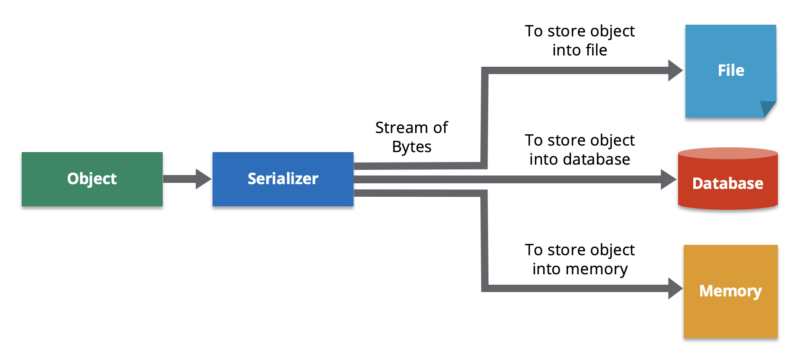
The reverse process—constructing a data structure or object from a series of bytes—is deserialization. The deserialization process recreates the object, thus making the data easier to read and modify as a native structure in a programming language.

Serialization enables us to save the state of an object and recreate the object in a new location. Serialization encompasses both the storage of the object and exchange of data. Since objects are composed of several components, saving or delivering all the parts typically requires significant coding effort, so serialization is a standard way to capture the object into a sharable format.
With serialization, we can transfer objects:
- Over the wire for messaging use cases
- From application to application via web services such as REST APIs
- Through firewalls (as JSON or XML strings)
- Across domains
- To other data stores
- To identify changes in data over time
- While honoring security and user-specific details across applications
https://hazelcast.com/glossary/serialization/
Serialization
Serialization is the process of converting a data object into a series of bytes that saves the state of the object in an easily transmittable form.
hazelcast.com
'Django' 카테고리의 다른 글
| Django - import 아임포트 결제 시스템 구현하기 (1) | 2023.11.24 |
|---|---|
| [Django] Connecting Frontend and Backend and Distribution 백엔드와 프런트엔드의 연결과 배포 (1) | 2023.10.31 |
| [Django] Postman - followings/followers serializers 설정 (0) | 2023.10.04 |
| [Django] Postman - refresh token 이용해서 login 하기 (0) | 2023.10.02 |
| [Django] postman 이용하여 수정하기 API 만들기 (0) | 2023.09.25 |